【数学】三角函数

三角函数\Huge\textsf{三角函数}


Chapter 1.\large\texttt{Chapter 1.} 特殊的三角函数值

本章节不允许使用初中范围外的知识!

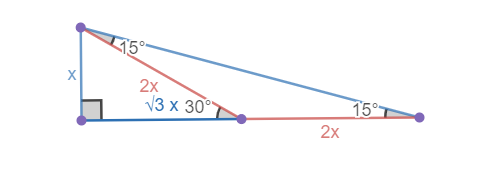
例1:求tan⁡15°.\tan 15 \degree .

这是经典题了,方法就是作30°.30 \degree .

易得 tan⁡15°\tan 15 \degree = 2−3.2 - \sqrt{3}.


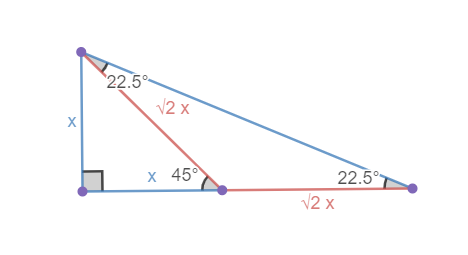
例2:求tan⁡22.5°.\tan 22.5 \degree .

有了第一题,这一题也很简单啦awa

易得 tan⁡22.5°\tan 22.5 \degree = 2−1.\sqrt{2} - 1 .


例3:求cos⁡36°\cos 36 \degree、cos⁡72°.\cos 72 \degree.

众所周知,顶角或底角为36°36\degree的等腰三角形,

都可以用一条线段分成一个顶角为36°36\degree的等腰三角形和一个底角为36°36\degree的等腰三角形。

我们就构造一个底角为36°36\degree的等腰三角形△ABC\triangle ABC,然后作出这条线段ADAD,设他为x。

然后设AB=kxAB = kx,则AC=DC=kxAC = DC = kx;

△ABD∼△CBA,  ∴BC=k2x,  DC=BC−BD=k2x−x.\triangle ABD \sim \triangle CBA ,\;\therefore BC = k^{2}x ,\;DC = BC - BD = k^{2}x - x.

∴k2x−x=kx,  \therefore k^{2}x - x = kx,\;解得k=5−12.k = \dfrac{\sqrt{5}-1}{2}.

之后就是两条垂线的事啦awa

最终cos⁡36°=5+14,  cos⁡72°=5−14.\cos 36 \degree =\dfrac{\sqrt{5}+1}{4},\;\cos 72 \degree = \dfrac{\sqrt{5}-1}{4}.


小拓展!\large\texttt{小拓展!}

黄金分割比5−12\dfrac{\sqrt{5}-1}{2},我们用Φ\Phi 表示。

顶角为 36°36\degree 的等腰三角形中,三边之比为 Φ:Φ:1\Phi:\Phi:1 ,这就是它为什么叫“黄金三角形”awa

底角为 36°36\degree 的等腰三角形中,三边之比为 1:1:Φ1:1:\Phi ,平几大典的编辑给它起了个名字“白金三角形”qwq


Chapter 2.\large\texttt{Chapter 2.} 三角函数的特殊题目

例5:

证明sin⁡10°\sin 10\degree 为无理数。

各位都知道有个二倍角公式,

但你知道三倍角公式吗?

sin⁡3α=3sin⁡α−4sin⁡3α\sin 3\alpha =3\sin \alpha - 4\sin^3\alpha

∴3sin⁡10°−4sin⁡310°=sin30°=12\therefore 3\sin 10\degree - 4\sin^3 10\degree = sin 30\degree = \dfrac{1}{2}

−8sin⁡310°+6sin⁡10°−1=0- 8\sin^3 10\degree +6\sin 10\degree -1 =0

设2sin⁡10°=x,  2\sin 10\degree =x ,\;则 $ x^3 - 3x + 1 =0,$

然后再用一个三次方程的判别式:Δ=q24+p327\Delta = \dfrac{q^2}{4} +\dfrac{p^3}{27},它不是有理数,

所以2sin⁡10°2\sin 10\degree不是有理数,那么sin⁡10°\sin 10\degree也就不是有理数。


例6:

证明平面直角坐标系内不存在三个顶点都是整点的正三角形。

出乎意料的简单!

假设正三角形为△OBC\triangle OBC ,O为原点,B、C都是整点,B在上,C在下,

则BO与y轴、CO与x轴的夹角的正切值都是分数。(自己想想为什么?

那么根据和差角公式:tan⁡(α+β)=tan⁡α+tan⁡β1−tan⁡αtan⁡β\tan (\alpha+\beta) = \dfrac{\tan \alpha + \tan \beta}{1 - \tan \alpha \tan \beta},这两个夹角的和的正切值一定是分数,余切值也一定是分数。

再根据诱导公式:tan⁡(π2−α)=cot⁡α\tan (\dfrac{\pi}{2} - \alpha) = \cot \alpha,中间那个角的正切值也一定是分数。

又因为tan⁡60°=3\tan 60\degree = \sqrt{3},是无理数,所以矛盾。


例7:

解方程:sin⁡7x+1sin⁡3x=cos⁡7x+1cos⁡3x\sin ^7 x + \dfrac{1}{\sin ^3 x} = \cos ^7 x + \dfrac{1}{\cos ^3 x}

肉眼可见第一种情况:sin⁡x=cos⁡x,  x=45°\sin x = \cos x ,\;x = 45\degree或$x = 135\degree . $

那如果不等呢?

首先移项:1sin⁡3x−1cos⁡3x=cos⁡7x−sin⁡7x,\dfrac{1}{\sin ^3 x} - \dfrac{1}{\cos ^3 x} = \cos ^7 x - \sin ^7 x,

通分:cos⁡3x−sin⁡3xsin⁡3xcos⁡3x=cos⁡7x−sin⁡7x.\dfrac{\cos ^3 x - \sin ^3 x}{\sin ^3 x\cos ^3 x} = \cos ^7 x - \sin ^7 x .

接下来的操作看好了!

由x3−y3=(x−y)(x2+xy+y2)x^3 - y^3 = (x-y)(x^2+xy+y^2)得,

左侧是(cos⁡x−sin⁡x)(cos⁡2x+cos⁡xsin⁡x+sin⁡2x)sin⁡3xcos⁡3x;\dfrac{(\cos x - \sin x)(\cos ^2 x + \cos x \sin x + \sin ^2 x)}{\sin ^3 x\cos ^3 x};

由xk−yk=(x−y)∗(xk−1y+xk−2y2+xk−3y3+……+x3yk−3+x2yk−2+xyk−1)x^k-y^k=(x-y)*(x^{k-1}y+x^{k-2}y^2+x^{k-3}y^3+……+x^3y^{k-3}+x^2y^{k-2}+xy^{k-1})得,

右边是

(cos⁡x−sin⁡x)(cos⁡6x+cos⁡5xsin⁡x+cos⁡4xsin⁡2x+cos⁡3xsin⁡3x+cos⁡2xsin⁡4x+cos⁡xsin⁡5x)(\cos x - \sin x)(\cos ^6 x + \cos ^5x \sin x + \cos ^4x\sin ^2x + \cos ^3x\sin ^3x + \cos ^2x\sin ^4 x+ \cos x\sin ^5x)

然后两边同时除以cos⁡x−sin⁡x\cos x - \sin x得,

cos⁡2x+cos⁡xsin⁡x+sin⁡2xsin⁡3xcos⁡3x=cos⁡6x+cos⁡5xsin⁡x+cos⁡4xsin⁡2x+cos⁡3xsin⁡3x+cos⁡2xsin⁡4x+cos⁡xsin⁡5x\footnotesize\dfrac{\cos ^2 x + \cos x \sin x + \sin ^2 x}{\sin ^3 x\cos ^3 x} = \cos ^6 x + \cos ^5x \sin x + \cos ^4x\sin ^2x + \cos ^3x\sin ^3x + \cos ^2x\sin ^4 x+ \cos x\sin ^5x

cos⁡2x+sin⁡2x=1,  ∴cos⁡xsin⁡x+1sin⁡3xcos⁡3x=cos⁡6x+cos⁡5xsin⁡x+cos⁡4xsin⁡2x+cos⁡3xsin⁡3x+cos⁡2xsin⁡4x+cos⁡xsin⁡5x\cos ^2 x + \sin ^2 x = 1 ,\;\therefore \footnotesize\dfrac{\cos x \sin x + 1}{\sin ^3 x\cos ^3 x} = \cos ^6 x + \cos ^5x \sin x + \cos ^4x\sin ^2x + \cos ^3x\sin ^3x + \cos ^2x\sin ^4 x+ \cos x\sin ^5x

这个恶心的式子怎么办呢?

设t=sin⁡xcos⁡xt=\sin x \cos x

则和平方公式得cos⁡4x+sin⁡4x=(cos⁡2x+sin⁡2x)2−2cos⁡xsin⁡x=1−2t,\cos ^4x + \sin ^4x = (\cos ^2x + \sin ^2x)^2 - 2\cos x \sin x = 1-2t ,

立方和公式得cos⁡6x+sin⁡6x=(cos⁡2x+sin⁡2x)(cos⁡4x−2cos⁡2xsin⁡2x+sin⁡4x)=1−3t2,\cos ^6x + \sin ^6x = (\cos ^2x + \sin ^2x)(\cos ^4 x -2\cos ^2x \sin ^2 x + \sin ^4 x) = 1 - 3t^2,

∴\therefore 左侧 =1+tt2=\dfrac{1+t}{t^2},

右侧=cos⁡6x+sin⁡6x+cos⁡xsin⁡x(cos⁡4x+sin⁡4x)+cos⁡2xsin⁡2x(cos⁡x+sin⁡x)+cos⁡3xsin⁡3x= \cos ^6x+ \sin ^6x + \cos x\sin x(\cos ^4x + \sin ^4x)+\cos^2x\sin^2x(\cos^x+\sin^x)+\cos^3x\sin^3x

=1−t3+t(1−t2)+t2+t3=−t3−2t2+t+1= 1-t^3 + t(1-t^2) + t^2+t^3 = -t^3 -2t^2 + t+1

∴1+tt2=−t3−2t2+t+1,  \therefore \dfrac{1+t}{t^2} = -t^3 -2t^2 + t+1 ,\;化简得−t6−2t5+t4+t3−t=1.-t^6-2t^5+t^4+t^3-t = 1.

这个Latex累死我了QWQ\tiny\textsf{这个Latex累死我了QWQ}

然鹅∣t∣≤12,  tmax=12,  |t| \leq \dfrac{1}{2},\;t_{max} = \dfrac{1}{2},\;代入得 ∣−t6−2t5+t4+t3−t∣≤1,  |-t^6-2t^5+t^4+t^3-t|\leq 1,\;所以不存在。

∴x=45°\therefore x = 45\degree或$x = 135\degree . $


这里是帮你算好的三角函数值哦qwq

考场上别忘了构造法awa

sin⁡\sin cos⁡\cos tan⁡\tan
15°15\degree 6−24\dfrac{\sqrt{6}- \sqrt{2}}{4} 6+24\dfrac{\sqrt{6}+ \sqrt{2}}{4} 2−32-\sqrt{3}
22.5°22.5\degree 2−22\dfrac{\sqrt{2-\sqrt{2}}}{2} 2+22\dfrac{\sqrt{2+\sqrt{2}}}{2} 2−1\sqrt{2}-1
36°36\degree 10−254\dfrac{\sqrt{10-2\sqrt{5}}}{4} 5+14\dfrac{\sqrt{5}+1}{4} 10−255+1\dfrac{\sqrt{10-2\sqrt{5}}}{\sqrt{5}+1}
72°72\degree 10+254\dfrac{\sqrt{10+2\sqrt{5}}}{4} 5−14\dfrac{\sqrt{5}-1}{4} 10+255−1\dfrac{\sqrt{10+2\sqrt{5}}}{\sqrt{5}-1}

附录:

1.画图软件:Desmos( 几何区 )

2.参考资料:《平几大典——60与正三角形》 +(不方便展示的材料)

3.转载请注明出处 (虽然应该不会有人来抄我这个小菜鸡的文章XD)\tiny\textbf{(虽然应该不会有人来抄我这个小菜鸡的文章XD)}